
Advancing Student Success Through Faculty Development Summer Book Club Program
By - November 17, 2026

There is a growing need to reframe learning as a collaborative partnership between students and instructors in allied health educational programs.1 Ideally, students would enter the classroom with a clear understanding of their learning preferences, prepared and motivated to engage with the material. In turn, instructors would design curricula that foster creativity, accommodate diverse learning styles, and promote active participation.
A review of literature focused on reading comprehension and learning implies that there is no one learning style that is best for an individual but rather a preference that can work in different educational settings2-6 and educators should be prepared to use a variety of teaching strategies to meet students’ needs to support student success.7 Evidence suggests that students value opportunities for input into their learning, benefit from frequent low-stakes assessments, and thrive with timely, constructive feedback.8
However, what is often lacking is institutional and cultural support for this shift. There is a notable gap in faculty-initiated allied health education programs designed for peer-to-peer support.9 The purpose of the summer nook club program was to engage and better equip allied health educators to respond to the evolving needs of today’s learners, and to cultivate environments where both students and faculty can succeed.
Creating a conversation around student success
The summer book club program began as a quality improvement initiative designed to strengthen existing programs and explore new ways to support student success. Seventy-seven faculty and staff members were invited to participate and the group represented programs across the allied health professions, including Clinical Laboratory Science (BS), Respiratory Care (BS), and Physical Therapy (DPT). Thirty-five faculty and staff members ultimately joined the summer book club program.
Participants received Becoming a Student-Ready College: A New Culture of Leadership for Student Success9 and were invited to take part in three two-hour virtual sessions. Rather than simply reviewing the book chapter by chapter, the sessions gave participants an opportunity to discuss its ideas, consider how they related to their own work, and identify ways to put them into practice.
The first conversation explored leadership values and organizational culture. The second turned to supporting student success in the classroom. The final session broadened the discussion to educating the whole student and encouraged participants to consider how the book’s concepts and strategies could be applied in their own programs.
The conversations themselves also became an important source of insight. After each session, the program coordinator summarized the discussion, capturing key takeaways, promising practices, and ideas for improvement.
At the end of the summer, participants were invited to share additional feedback through an anonymous online evaluation administered through Qualtrics. The survey used branching logic and included both multiple-choice and open-ended questions (Table 1), giving participants an opportunity to evaluate the experience and elaborate on their responses. The survey remained open for four weeks.
Table 1. Sample Survey Questions
| To what extent did you read the book Becoming a Student-Ready College: A New Culture of Leadership for Student Success? | Likert Scale Not at all - A great deal (5 categories) |
| To what extent did you attend the Summer Book Program discussion sessions? | o Unable o 1 session o 2 sessions o 3 sessions |
| I feel that the content that I read about in the book was valuable in understanding current issues that may impact student success. | Likert Scale Strongly Agree – Strongly Disagree (5 categories) |
| I feel that the content that I read about in the book was valuable in learning about strategies to improve student success. | Likert Scale Strongly Agree – Strongly Disagree (5 categories) |
| I feel that the group discussion sessions were valuable in learning about current issues that may impact student success | Likert Scale Strongly Agree – Strongly Disagree (5 categories) |
| I feel that the group discussion sessions were valuable in learning about strategies to improve student success. | Likert Scale Strongly Agree – Strongly Disagree (5 categories) |
A two-column table providing sample survey questions with corresponding response options. Questions focused on the extent of reading and participating in discussion sessions, as well as perception of the value of the book and discussions.
Lessons from the conversation
Of the 35 faculty and staff members who participated in the summer book club program, 29 completed the online evaluation. Their responses pointed to several common themes: the value of the book itself, the importance of discussing its ideas with colleagues, and a shared recognition that supporting students requires attention to more than academic performance alone.
Engagement with the book was strong, with 66 percent of respondents reporting that they read most of it. More importantly, participants found the content relevant to their work. Ninety-three percent agreed that the book helped them better understand current issues that can affect student success, and the same percentage said it introduced effective strategies for supporting students.
But the book was only part of the experience. The group conversations gave participants an opportunity to explore those ideas together and connect them to the challenges they encounter in their own classrooms and programs. While attendance varied across the three sessions, 95 percent of respondents said the discussions deepened their understanding of the challenges students face, and 90 percent said the sessions helped them identify strategies for providing support.
Those who read more of the book also tended to participate more often in the discussions, with analysis showing a correlation between the extent of reading and session attendance (p < 0.1). Together, the findings suggest that engaging with the material and reflecting on it with colleagues reinforced one another, helping participants move from understanding the concepts to considering how they might apply them.
The conversations also revealed something less easily captured by numbers: a shared vision of what student support should look like. In their open-ended feedback, participants repeatedly returned to the idea of the “caring educator” and emphasized empathy, respect, and inclusivity as essential elements of a supportive campus environment.
These themes broadened the conversation about student success beyond classroom instruction alone. Participants recognized the importance of attending to students’ emotional and social experiences and of creating learning environments in which students feel supported as whole people (Table 2).
Table 2. Common Themes to Open-Ended Survey Questions
A two-column table summarizing the common themes identified for four of the qualitative survey questions related to student success. Common themes include motivating inclusiveness, faculty and staff development, as well as improved student support and resources.
One notable comment included:
“It is imperative that we recognize the significance of addressing the personal/social needs of students and how these supports can impact student success.”
Participants also identified key strategies they believed would best support student achievement. The top three included:
Workshops about access to resources
Study skill development
Informal interactions with faculty and staff
Figure 1. The top three rankings that participants felt most valuable for STUDENTS to improve success.
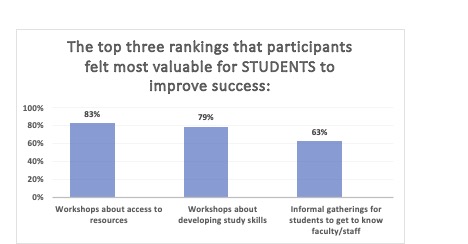
A bar graph plotting the percentage of participants that reported value to three student resources aimed at improving success. Workshops about access to resources received the top ranking (83%). This was followed by workshops aimed at developing study skills (79%) and informal gatherings for students to interact with faculty and staff (63%).
In terms of faculty and staff support, the highest-ranked priorities were:
Professional development in leadership and skill-building
Targeted advising strategies in school/life balance and career development
School and University initiatives to promote student wellness
These rankings emphasize a shared responsibility in student success and the need for an institution-wide investment.
Figure 2. The top three rankings that participants felt most valuable for FACULTY/STAFF to improve student success
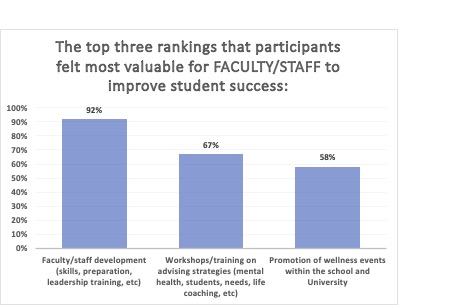
A bar graph plotting the percentage of participants that reported value to three faculty/staff resources aimed at improving student success. Faculty/staff development received the top ranking (92%), followed by workshops on advising strategies for various student needs (67%) and the promotion of wellness events (58%).
Faculty development resonated with participants
The summer book club program provided a unique opportunity for important discussions related to student success. Respondents to the survey placed value in the interprofessional approach. There was agreement that the content of the book and the participation in the discussion sessions were important to understanding issues that affect student success and learning about strategies to support them. An important theme that resonated was the importance of faculty development and the need for improved resources (webinars, soft skill development) to support both faculty and students.
The data underscore the potential of the book club model as a vehicle for professional development related to student success. Given the ease of facilitating virtual discussions, implementing similar programs within colleges and universities appears highly feasible, and can serve as a catalyst for initiatives ranging from small-scale actions to comprehensive institution-wide changes.
The main strength of the program was its interprofessional collaborative nature, which offered a broader perception across disciplines. The primary limitation of the evaluation was that the book discussions were based solely on faculty perceptions, rather than incorporating direct student input. Future initiatives should encourage student participation to ensure their voices are meaningfully integrated into the process. Moreover, future programs should include more robust assessment methods to evaluate how the ideas generated during the workshop were implemented across programs, and to measure improvements in student success.
Promising steps forward
The faculty development program for student success represents a promising first step toward reimagining how institutions can support both educators and students in the current educational landscape. To improve learning environments, institutions must cultivate empathetic, respectful, and inclusive classroom and campus environments, as well as ensuring equitable access to resources for both students and faculty. Equally critical is the development of faculty and staff through student-centered professional learning opportunities. This includes initiating honest, open conversations, followed by the implementation of standardized training programs that equip educators with the skills to respond effectively to diverse student experiences. By shifting the focus from student preparedness to institutional readiness, the initiative fostered a reflective and action-oriented environment aimed at reimagining policies and pedagogies to better support undergraduate and graduate learners.
References
Hattie, J., O’Leary, T. Learning Styles, Preferences, or Strategies? An Explanation for the Resurgence of Styles Across Many Meta-analyses. Educ Psychol Rev. 2025; 37, 31. Available from: https://doi.org/10.1007/s10648-025-10002-w
Dong, Yang., Xiaoying Wu, Sammy., Wang, Weisha., Peng, Shuna. Is the Student-Centered Learning Style More Effective Than the Teacher-Student Double-Centered Learning Style in Improving Reading Performance? Frontiers In Psychology. 2019; 10: 1-10. Available from: https://doi.org/10.3389/fpsyg.2019.02630.
Kissau, S., & Hiller, F. Reading comprehension strategies: An international comparison of teacher preferences. Research in Comparative and International Education. 2013; 8(4), 437-454.
Rogowsky, B. A., Calhoun, B. M., & Tallal, P. Matching learning style to instructional method: Effects on comprehension. Journal of educational psychology. 2015; 107(1), 64.
Rujani, Muhammad. Correlational Study Between Learning Style and Reading Comprehension at University Level Students. Advances in Social Science, Education and Humanities Research. 2019; 317: 45 – 50. Available from: https://doi.org/10.2991/iconprocs-19.2019.9
Enochs, J. R., H. M. Handley, and J. P. Wollenberg. Relating Learning Style, Reading Vocabulary, Reading Comprehension, and Aptitude for Learning to Achievement in the Self-Paced and Computer-Assisted Instructional Modes. The Journal of Experimental Education. 1986; 54 (3): 135–39. Available from: doi:10.1080/00220973.1986.10806411.
Lyle, Keith B., Andrea S. Young, Robin J. Heyden, and Mark A. McDaniel. Matching Learning Style to Instructional Format Penalizes Learning. Computers and Education Open 5. 2023 December; 100143. Available from: https://doi.org/10.1016/j.caeo.2023.100143.
Cromley, Jennifer G., Azevedo, Roger. Testing and Refining the Direct and Inferential Mediation Model of Reading Comprehension. Journal of Educational Psychology. 2007; 99 (2): 311-325.
McNair, T. B., Albertine, S., McDonald, N., Major Jr, T., & Cooper, M. A. Becoming a student-ready college: A new culture of leadership for student success. John Wiley & Sons; 2022.
